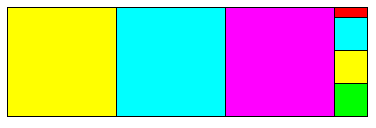
The Golden Ratio, denoted by the Greek letter phi, is one of the most famous constants in mathematics.
Its value is (1 + sqrt(5))/2, or
         ___
        /
 1 +   /  5
     \/
-------------
     2
Its value is approximately 1.6180339887..., and its most notable property is that if you have a rectangle, the sides of which are in the Golden Ratio to each other, if you remove from it a square with the smaller side of the rectangle as its side, the smaller rectangle that is left will also have sides that are in the Golden Ratio to each other. This is illustrated at right.
This means that phi satisfies the equation
 x       1
--- = -------
 1     x - 1
which simplifies, through cross-multiplication, to
 2
x  - x = 1
which is usually rearranged to
 2
x  = x + 1
Also, the Golden Ratio is the limit of the ratio between successive terms of the Fibonacci sequence,
1, 1, 2, 3, 5, 8, 13, 21, 34, 55, 89, 144, 233...
which begins with two ones, and then each succeeding term is the sum of the two previous terms.
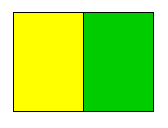
Instead of taking a square away from a rectangle, if one takes away a smaller rectangle of the same shape to leave an identical smaller rectangle of the same shape, then the ratio of the rectangle's sides must be the square root of two.
And this is a ratio very useful for being able to print pages with the same appearance in different sizes.
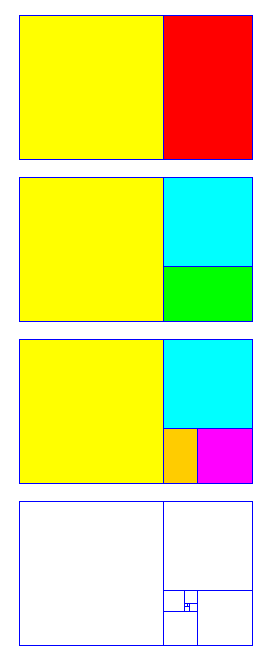
The Silver Ratio was, in ancient times, considered to be the next logical step after the Golden Ratio. Its symbol is the lowercase letter sigma.
Instead of taking away one square from a rectangle to leave a smaller but similar rectangle, what if you could take away two squares? This is illustrated at right.
This ratio has the value
        ___
       /
1 +   /  2
    \/
or approximately 2.41421356.... , making it simpler than the Golden Ratio.
It solves the equation
 2
x  = 2x + 1
Here is a name I've coined myself, as the natural name for the number that solves the equation
 2
x  = 3x + 1
for a rectangle from which three squares are taken, leaving a small rectangle similar to it.
And here is the diagram illustrating that property:
That would have the value
         ____
        /
 3 +   /  13
     \/
--------------
      2
or approximately 3.3027756... .
This value, though, isn't my own invention; this value, and its further successors, are known as silver means.
This number, commonly denoted by the letter rho, is another cousin of the Golden Ratio. Its value is approximately 1.324717957... , and it is the solution of the equation
 3
x  = x + 1
As this is a cubic ratio, its value is a bit more complicated; it is
      ___________________          ____________________
     /             _____          /             _____
    / 1     1     /  23          / 1     1     /  23
   / --- + ---   /  ----   +    / --- - ---   /  ----
3 /   6     3  \/     3      3 /   6     3  \/     3
\/                           \/
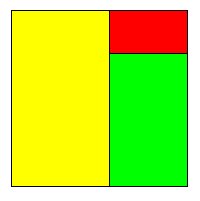
The square of the Plastic Ratio, approximately 1.75487767..., can be used to make a rectangle which, when taken away from a square, leaves a smaller rectangle which, once a smaller rectangle in that proportion is taken away, leaves a smaller rectangle also in that proportion. This is illustrated by the diagram on the left.
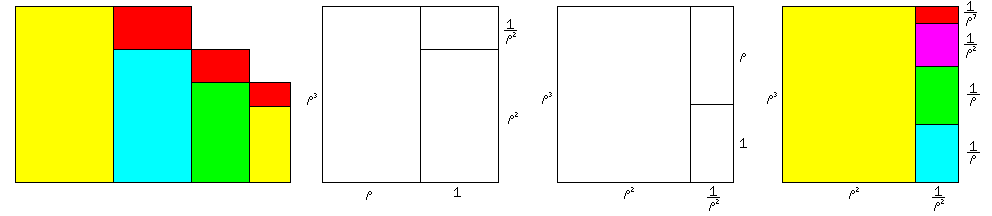
And the diagram below shows, on the left, how this square can be repeated; in the second part, how the lengths of the sides of the three rectangles into which the square is divided relate to the polynomial of which the plastic ratio is the root; and, in the third part, how that makes it obvious that another property exists: if one takes a rectangle in the proportions of the Plastic Ratio itself, rather than its square, away from a square, then the remaining area may be filled with two rectangles, one in the proportion of the Plastic Ratio squared, and the other in the proportion of the Plastic Ratio cubed. (And if the thin strip to the right of the rectangle in the proportions of the Plastic Ratio itself is left alone, rather than being divided into two component rectangles, then it is in the proportions of the Plastic Ratio to the fifth power.)
And finally, on the right, another way in which the thin strip in the proportions of the Plastic Ratio to the fifth power can be divided is shown: into two rectangles in the proportion of the Plastic Ratio, one square, and one small rectangle in the proportions of the Plastic Ratio to the fifth power again.
The Plastic Ratio was discovered by Axel Thue in 1912. It was rediscovered by Gérard Cordonnier in 1924, who referred to it as the "radiant number"; in 1958, Cordonnier gave lectures in which he described how this ratio had shown up in architecture and other places.
The Plastic Ratio is the limit of the ratio between successive terms in the Padovan sequence. This sequence is analogous to the Fibonacci series, but this time, the sequence starts with three ones, and each further term is the sum of the first two terms of the previous three terms.
Thus, it runs as follows:
1, 1, 1, 2, 2, 3, 4, 5, 7, 9, 12, 16, 21, 28, 37, 49...
And there is yet another member of this family.
Denoted by the letter psi, the Supergolden Ratio is the solution of
 3    2
x  = x  + 1
Its value is approximately 1.46557123... , and can be expressed as
                           1
--------------------------------------------------------
      ___________________          ____________________
     /             _____          /             _____
    / 1     1     /  31          / 1     1     /  31
   / --- + ---   /  ----   +    / --- - ---   /  ----
3 /   2     6  \/     3      3 /   2     6  \/     3
\/                           \/
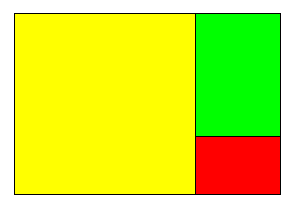
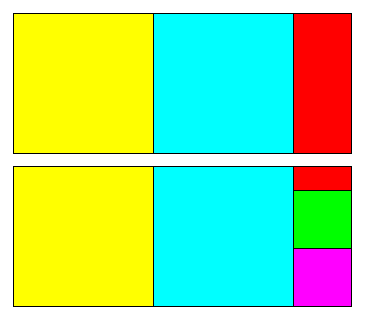
Here, if you remove a square from a rectangle with sides in this ratio, you leave a narrower rectangle, which can be divided into two unequal rectangles oriented at right angles to one another with sides in this ratio, as shown in the image at right.