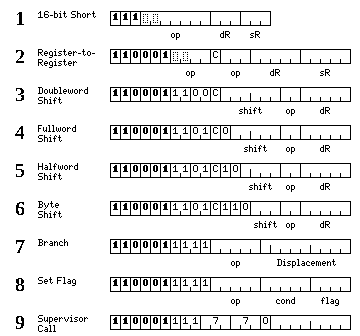
The instructions to be described in this section have the formats shown in this diagram:
The first line of the diagram shows the 16-bit short instructions; the remainder of the diagram shows the 24-bit short instructions.
The short instructions do not include memory-reference instructions, or the subroutine jump instruction. However, while the set of 24-bit instructions is therefore not complete in itself, it is sufficient that a large proportion of the instructions in a program could be 24-bit instructions.
Line 1 gives the format of the 16-bit short instructions.
The seven-bit opcodes of the 16-bit short instructions are the same as those of the 24-bit register-to-register short operate instructions shown in line 2. However, these instructions cannot affect the condition codes, and may only operate on the first eight registers in either of the two register banks.
The source and destination registers may not be the same for a 16-bit operate
instruction. Instead, these bit combinations indicate 16-bit instruction prefixes for use
in extending the instruction set. Those which start with
1110 are prefixes for new instruction sets which retain the existing
length coding of the main instruction set.
Those which start with 11110 instead prefix instruction sets
in which all the instructions are the same length, as follows:
170x00  32 bits
170x11  64 bits
170x22  80 bits
170x33 128 bits
170x44 144 bits
170x55 160 bits
170x66 176 bits
170x77 192 bits
Line 2 gives the format of the operate instructions from among the 24-bit short instructions. Integer instructions reference the integer registers, and floating-point instructions reference the floating-point registers, as might be expected.
There are 96 possible opcodes, as the first two bits of an opcode may not be both 1, as these combinations are reserved for other 24-bit instructions.
The opcodes (with the first four bits appearing along the top of the chart, and the last three bits appearing on the right) are:
   0     10     20     30     40     50     60     70    100    110    120    130
0000   0001   0010   0011   0100   0101   0110   0111   1000   1001   1010   1011

       IB     DEUH   IH     DEU    I      DEUL   SW     SWM    SWF    SWD    SWQ    000 0
CB     XB     CH     XH     C      X      CL     XL     CM     CF     CD     CQ     001 1
LB     ULB    LH     ULH    L      UL     LL     SWL    LM     LF     LD     LQ     010 2
STB    DUB    STH    DUH    ST     DU     STL    DUL    STM    STF    STD    STQ    011 3
AB     NB     AH     NH     A      N      AL     NL     AM     AF     AD     AQ     100 4
SB     OB     SH     OH     S      O      SL     OL     SM     SF     SD     SQ     101 5
MB     SWB    MH     MEH    M      ME     ML     MEL    MM     MF     MD     MQ     110 6
DB     SWH    DH     DEH    D      DE     DL     DEL    DM     DF     DD     DQ     111 7
The different instructions are:
For integer types:
M     MULTIPLY            Multiply the contents of the source and destination locations, placing the
                          least significant part of the result of the same length as the two input
                          operands in the destination location, with sign extension if that is shorter
                          than the length of the destination register

D     DIVIDE              Divide the contents of the source location by the contents of the destination
                          location, placing the quotient in the destination location

L     LOAD                Place the contents of the source operand in the destination register;
                          if the type involved is smaller than the register, perform sign extension

ST    STORE               Fill the destination location from the least significant part of the
                          source location

A     ADD                 Add the contents of the source and destination locations, placing the
                          result in the destination location

S     SUBTRACT            Subtract the contents of the source location from those of the destination
                          location, placing the result in the source location

SW    SWAP                Exchange the contents of the source and destination locations

C     COMPARE             Subtract the contents of the source location from the contents of
                          the destination location, but with the operation modified so that
                          overflow cannot possibly result, and set the condition codes appropriately
                          without modifying the destination location

I     INSERT              Fill the least significant bits of the destination register with
                          the contents of the source location, leaving the rest of the destination
                          register unaffected

X     EXCLUSIVE OR        Perform a bitwise Exclusive OR operation between the contents of the source
                          and destination locations, placing the result in the desination location

UL    UNSIGNED LOAD       Fill the least significant bits of the destination register with
                          the contents of the source location, and clear the remaining more
                          significant bits of the destination register

DU    DIVIDE UNSIGNED     Divide the contents of the source location by the contents of the destination
                          location, considering both as unsigned integers, placing the quotient in the
                          destination location

N     AND                 Perform a bitwise Logical AND operation between the contents of the source
                          and destination locations, placing the result in the desination location

O     OR                  Perform a bitwise Logical OR operation between the contents of the source
                          and destination locations, placing the result in the desination location

ME    MULTIPLY EXTENSIBLY Multiply the contents of the source and destination locations. Take the
                          full product, as an integer having twice the size as that of the source
                          and the destination, and:
 - in the case of the halfword and integer versions of the instruction, place it in the destination
   register, with sign extension in the halfword version;
 - in the case of the long version of the instruction, place the most significannt half of the result
   in the destination register, which must be an even-numbered register, and place the least significant
   half of the result in the register following

DE    DIVIDE EXTENSIBLY   Divide a destination operand of twice the length of that indicated by the
                          instruction type (and located as the result of the MULTIPLY EXTENSIBLY
                          instruction) by the source operand; store the double length quotient
                          in the destination location (again following the MULTIPLY EXTENSIBLY
                          result placement) and the single length remainder in the next register
                          following those that are used.
                             Whenever a result is not wide enough to fill a register, sign extension
                          is performed.
                             Division is performed giving a result as if both operands were converted
                          to positive numbers before starting, with the signs then set afterwards
                          to give a correct result based on the actual signs of the operands. Thus
                          both the quotient and the remainder will be positive or zero if the dividend
                          and divisor have the same sign, and both will be negative or zero if they
                          are of opposite signs.

DEU   DIVIDE EXTENSIBLY UNSIGNED  This instruction also uses a dividend, and gives a quotient, at
                                  double the length indicated by the instruction type, while the
                                  divisor and the remainder are at the actual length the instruction
                                  type indicates; it differs by acting on unsigned integers.
The possible integer types, and the suffixes that indicate them, are:
B     BYTE      An 8-bit two's complement integer
H     HALFWORD  A 16-bit two's complement integer
      INTEGER   A 32-bit two's complement integer
L     LONG      A 64-bit two's complement integer
The integer registers are 64 bits long, to contain the longest of these types.
The available floating-point operations are SWAP, LOAD, STORE, ADD, SUBTRACT, MULTIPLY, and DIVIDE. Their functions are basically the same as those of the corresponding integer operations, except that floating-point arithmetic is performed.
The possible floating-point types for 16-bit instructions, and the suffixes that indicate them, are:
M     MEDIUM    A 48-bit floating-point number (preferably aligned on 16-bit boundaries)
F     FLOATING  A 32-bit floating-point number
D     DOUBLE    A 64-bit floating-point number
Q     QUAD      A 128-bit floating-point number
with their formats as indicated within this diagram:
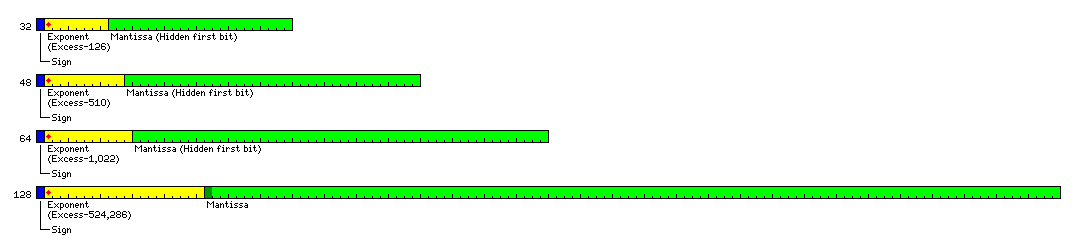
Note that in the diagram, exponents for the types other than the 128-bit internal type are given as excess-126, excess-510, and excess-1022; documentation for the IEEE 754 standard, and most descriptions of it, refer to the exponents as excess-127, excess-511, and excess-1023 instead. This is because these accounts place the binary point of the mantissa in front of its first visible bit, while I place it in front of the hidden first bit to remain in accord with the convention used in most other floating-point formats that the mantissa is in the range [0.1). In the case of the 128-bit internal form, as the first bit of the mantissa is now the bit which would have been the hidden bit, since for the other forms, I had been placing the binary point in front of the hidden bit, the offset is consistent by remaining two less than a power of two; this would need to be the case even if I had used the normal convention for the exponents of the other formats.
The IEEE 754 standard for floating-point arithmetic includes new standard formats for 128-bit and 256-bit numbers. The format for 128-bit numbers shown above does not correspond to this standard, as it instead has no hidden bit, and is similar in its general plan to the 80-bit temporary real format used with the Intel 8087 math coprocessor. However, the exponent field in that temporary real format was only 15 bits in length; this format, instead, has an exponent field 20 bits in length./p>
This is because the format for the usual format for 128-bit numbers, while not corresponding to the new IEEE 754 standard, has been influenced by it; the exponent field is one bit longer than that of standard 256-bit floats, so that these 128-bit numbers will have the same size of exponent as an internal form for floating-point numbers suitable for supporting all the standard types of IEEE 754 floating-point numbers, including the new 128-bit and 256-bit ones.
Lines 3 through 6 of the diagram illustrate the shift and rotate short instructions. These are:
3770x00x  LSLLC   Logical Shift Left Long Compact
3770x04x  LSRLC   Logical Shift Right Long Compact
3770x10x  RLLC    Rotate Left Long Compact
3770x14x  ASRLC   Arithmetic Shift Right Long Compact

3772x00x  LSLC    Logical Shift Left Compact
3772x04x  LSRC    Logical Shift Right Compact
3772x10x  RLC     Rotate Left Compact
3772x14x  ASRC    Arithmetic Shift Right Compact

3773000x  LSLHC   Logical Shift Left Halfword Compact
3773004x  LSRHC   Logical Shift Right Halfword Compact
3773010x  RLHC    Rotate Left Halfword Compact
3773014x  ASRHC   Arithmetic Shift Right Halfword Compact

3773400x  LSLBC   Logical Shift Left Byte Compact
3773404x  LSRBC   Logical Shift Right Byte Compact
3773410x  RLBC    Rotate Left Byte Compact
3773414x  ASRBC   Arithmetic Shift Right Byte Compact
Logical right and left shifts insert zeroes; the arithmetic right shift inserts a copy of the existing value of the most significant bit into the leftmost position of the word so as to maintain the sign as either negative or non-negative.
An arithmetic left shift inserts zeroes into the leftmost end of a number regardless of its sign, just like a logical left shift, but it differs in that the overflow bit is set if a left shift results in a change of the sign of the value being shifted, instead of merely a carry out of that value; this difference is, however, not applicable to short instructions, as they may not alter the condition codes, not having space for a C bit.
In the 16-bit short instructions, there is no available separate region of opcode space for the rotate instructions, and so instead the arithmetic left shift is replaced by rotate left.
Line 7 of the diagram shows the branch instructions.
The displacement is a 9-bit signed value, in two's complement form, which may vary from -256 to +255. The displacement is in bytes, not units of 16 bits, due to the existence of 24-bit short instructions. A displacement of zero refers to the position immediately following the instruction.
The available branch instructions are:
37740xxx  NOP   No Operation
37741xxx  BLR   Branch if Low Raw
37742xxx  BER   Branch if Equal Raw
37743xxx  BLER  Branch if Low or Equal Raw
37744xxx  BHR   Branch if High Raw
37745xxx  BNER  Branch if Not Equal Raw
37746xxx  BHER  Branch if High or Equal Raw
37747xxx  B     Branch

37751xxx  BM    Branch if Minus
37752xxx  BZ    Branch if Zero
37753xxx  BMZ   Branch if Minus or Zero
37754xxx  BP    Branch if Plus
37755xxx  BNZ   Branch if Not Zero
37756xxx  BPZ   Branch if Plus or Zero
37757xxx  BNV   Branch if No Overflow

37761xxx  BL    Branch if Low
37762xxx  BE    Branch if Equal
37763xxx  BLE   Branch if Low or Equal
37764xxx  BH    Branch if High
37765xxx  BNE   Branch if Not Equal
37766xxx  BHE   Branch if High or Equal
37767xxx  BNC   Branch if No Carry

37770xxx  BC    Branch if Carry
37771xxx  BV    Branch if Overflow
The instructions from Branch if Minus to Branch if Plus or Zero are intended for use after floating-point operations or operations on signed integers. The instructions from Branch if Low to Branch if High or Equal are intended for use after operations on unsigned integers.
Line 8 of the diagram of short instructions shows how condition values that are invalid result instead in an additional category of instructions which affect the flags used for predicated instructions.
37772xxx  SFC   Set Flag on Condition   Set flag to 1 if condition met; leave it unaffected otherwise
37773xxx  CFC   Clear Flag on Condition Set flag to 0 if condition met; leave it unaffected otherwise
37774xxx  CTF   Condition to Flag       Set flag to 1 if condition valid; set flag to 0 if condition not met
Line 9 of this diagram shows how an additional invalid condition value provides another special instruction:
37777xxx SVC Supervisor Call
This instruction performs the equivalent of an interrupt from within software, allowing portions of the operating system not running in supervisor state to request services from the kernel, as well as possibly also allowing user programs to request services from the operating system.
On the next page, we will see three classes of long instructions, 48 bits, 80 bits, and 112 bits in length, which allow an explicit indication of parallelism, and, in the case of the 48-bit instructions of this type, predication as well, to be associated with one, two, or three 32-bit instructions respectively.
These instructions also allow paired 16-bit short instructions, the format of which will be shown on the next page, that allow the use of all 32 registers in each register bank to be used as source or destination registers.
However, these instructions may only be register-to-register operate instructions.
In addition to those paired short instructions, regular 32-bit instructions, but not instructions of any other length, may be included.
Were it not for the Halfword Immediate instruction, this would leave available
all the opcode space occupied by instructions beginning with 11.
Hence, as illustrated below, the Halfword Immediate instruction is replaced by a more limited alternate form of it among these embedded 32-bit instructions, so that paired short instructions which occupy only half of a 32-bit word, and yet allow additional instruction types, similar to those provided with 24-bit short instructions, in addition to two-operand register-to-register short instructions.
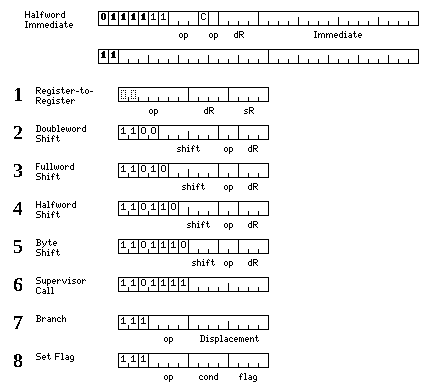
The paired short instructions, here, use the opcode space which is normally used for most of the instructions longer than 32 bits; the modified Halfword Immediate instruction uses the opcode space which is normally used for the 24-bit short instructions.