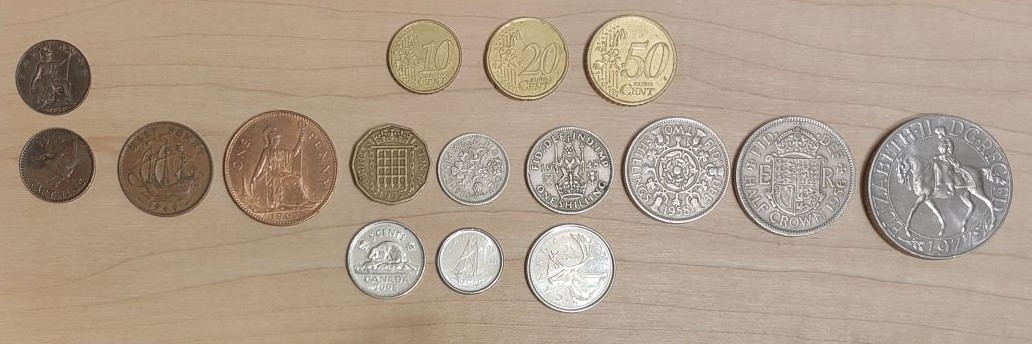
The image below illustrates the coins of Britain prior to decimalisation:
The top row begins with an older farthing, with the same design on its reverse as the penny. Then, in the middle of the image, in the top row, we see coins for 10, 20, and 50 cents of the Euro, to give people in the Eurozone a basis for size comparison.
It is in the middle row that we see typical coins of the pre-decimal days, although I chose to represent the shilling with an older version.
From left to right, we see:
The farthing, the halfpenny, and the penny, each one larger than the one before, these coins being made of bronze.
The threepence coin; this coin is made of nickel brass, and is twelve-sided instead of round.
The sixpence, the shilling, the florin, the half crown, and the crown, each one larger than the one before. These coins are made of cupronickel, and were originally made of 92.5% fine silver, or sterling silver.
In the bottom row, a Canadian 5 cent piece, 10 cent piece, and 25 cent piece are shown, again for size comparison. These Canadian coins are the same size as their American counterparts, the nickel, dime, and quarter... which names we also use in Canada for our corresponding coins, though occasionally Canadian nationalists will tell us that we really shouldn't.
Prior to decimalisation, as the British spell it, having escaped the corrupting influence of Noah Webster (though not the even more pernicious influence of Samuel Johnson, what with his 1775 dictionary that is often blamed for making English spelling etymological rather than phonetic, some would say), the British pound was divided into twenty shillings, and each shilling was divided into (gasp, horror) twelve pence.
Thus, the values of the coins in the middle row of the image above, from left to right, are:
The British, being three resilient peoples (the English, the Scots, and the Welsh), were able to make change when shopping in daily life without going insane, and, indeed, without much in the way of visible evidence of difficulty.
However, when it comes time to calculate compound interest to the farthing, doing so is a bit more awkward than with a decimal currency. The British coped with this in a number of ways. For one thing, pre-calculated tables of compound interest were drawn up for the use of those concerned. And just as some computers used to do calculations in packed decimals, wherein each four bits of a number only represented a digit which varied from 0 to 9, rather than taking on all sixteen possible values, some British computers actually had circuits wired so as to perform arithmetic on quantities in sterling - thus, a regular binary number could multiply a sterling value, consisting of a binary number of pounds, followed by five bits representing shillings from 0 to 19, and then four bits representing pence from 0 to 11... or perhaps six bits representing farthings from 0 to 47 if necessary, although the farthing, having been abolished in 1956, unlike the halfpenny, did not make it very far into the computer age. Perhaps another five bits, representing halfpennies from 0 to 23, then.